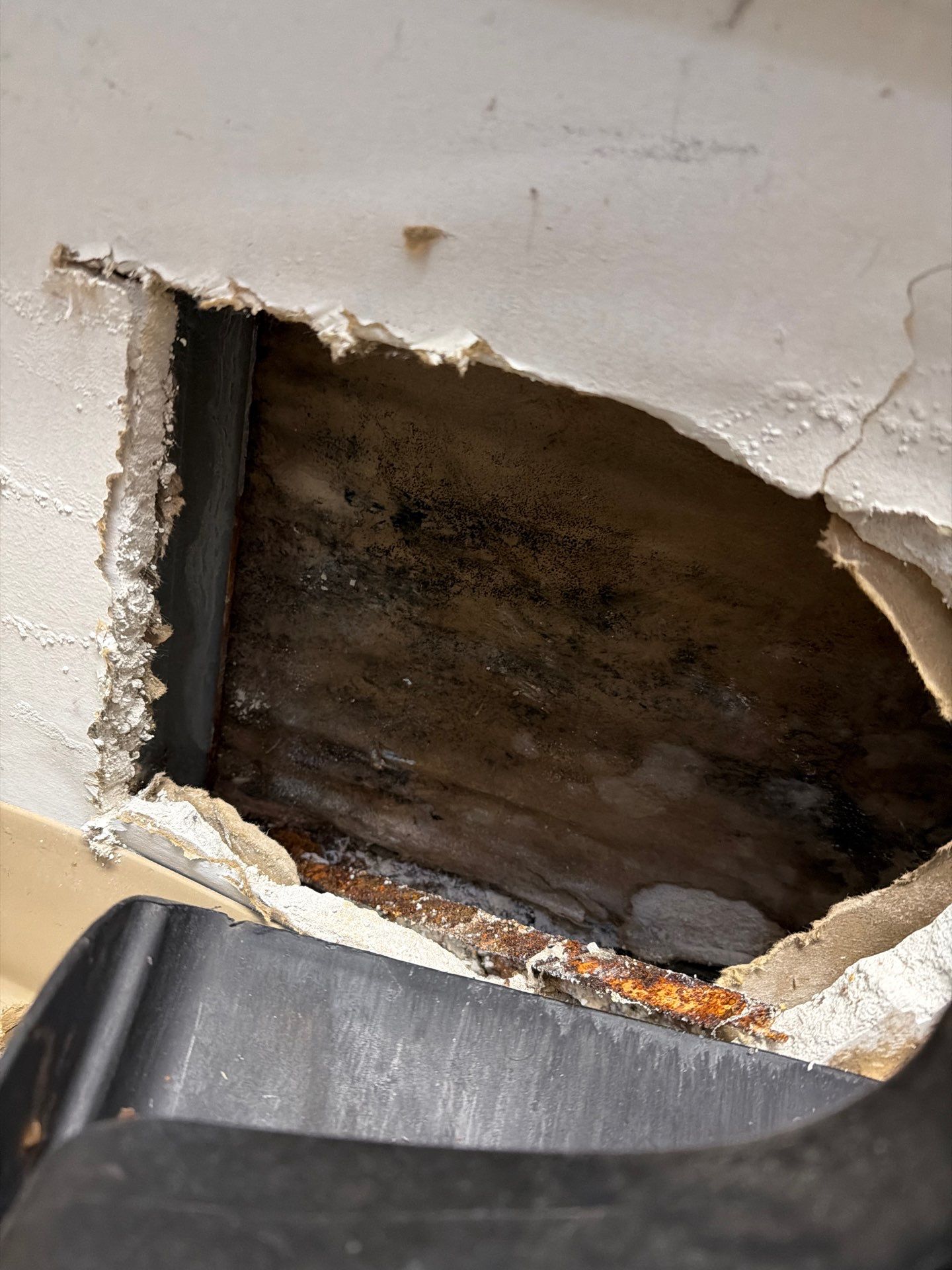
Problem 1: You Cannot See How Far the Water Spread
The visible puddle in front of your dishwasher is almost never the full story. Water follows gravity and the path of least resistance, which usually means it runs under the dishwasher pan, into the cavity beside the cabinet, and along the seam where your subfloor meets the wall. In a Eagle Village home with hardwood or laminate, that hidden moisture will warp planks from underneath days after the leak appears to be over.
The Fix: Moisture Mapping Before Repair
Before any repair quote means anything, the affected area needs to be mapped with a calibrated moisture meter and a thermal camera. We document readings at the toe-kick, two feet out from the dishwasher, the adjacent cabinet base, and the wall plate behind the unit. Anything reading above 16 percent moisture content in wood subfloor needs active drying. This documentation also becomes the backbone of your insurance claim, which matters because adjusters reject vague damage descriptions every day. We also check the basement ceiling or crawl space directly below the kitchen, because water that ran through a gap in the subfloor often pools on a joist or drywall sheet one floor down without leaving any obvious sign in the kitchen itself.
Problem 2: The Subfloor Is Already Compromised
Most kitchens in Eagle Village sit on either OSB or plywood subfloor over joists. OSB swells when wet and does not return to its original dimension once dried. Plywood holds up slightly better but delaminates if saturation lasts more than 48 to 72 hours. You will notice this as a soft spot when walking, a squeak that was not there before, or visible separation between flooring planks.
The Fix: Cut, Dry, or Replace Based on Category
The IICRC classifies water by source. A clean supply line leak is Category 1, which means the subfloor can often be dried in place with air movers and dehumidifiers over three to five days. A drain line leak from the dishwasher pump is Category 2 (gray water) and usually requires removing and replacing the wet portion of subfloor for sanitation reasons. If the leak sat for weeks and mold has started, you are likely in Category 3 territory, and we handle that the same way we approach any professional water damage restoration project: containment first, removal second, rebuild last. The cut lines matter too. We always extend the removal at least six inches past the last wet reading, fasten new subfloor to the joists with construction adhesive and ring-shank nails, and seal the seams before any finish flooring goes back down.
Problem 5: The Clock Is Working Against You
Mold can begin colonizing wet cellulose materials within 24 to 48 hours. Cabinet swelling becomes irreversible after about 72 hours. Hardwood cupping starts almost immediately and gets worse the longer water sits.
The Fix: Call Within the First Day
If your leak happened in the last 24 hours, you have options. If it has been a week, your options narrow and your costs climb. We respond across Eagle Village and Central Indiana around the clock, and the same urgency logic applies whether your problem is a dishwasher, a burst pipe, or a backed-up drain. Speed protects materials, your claim, and your budget.
Problem 4: You Do Not Know What Insurance Will Cover
Sudden and accidental discharge from a household appliance is a covered peril on most standard homeowner policies in Indiana. Gradual leaks that went unnoticed for months are usually excluded. The difference between those two categories is where claims get won or lost.
The Fix: Document Like the Adjuster Will Be Skeptical
Here is the documentation checklist we use on every Eagle Village dishwasher claim:
- Photograph the dishwasher in place, the supply line, the drain hose, and any visible water before anything is moved.
- Save the failed part (cracked inlet valve, split hose, corroded pump housing) and photograph it next to the unit.
- Get moisture readings in writing with timestamps, plus a scope of work describing every wet material by square footage.
For a deeper breakdown of pricing line items, our water damage restoration cost guide walks through equipment rental, labor, and reconstruction in detail. Call your insurer the same day you find the leak, get a claim number, and ask whether your policy includes ALE (additional living expense) coverage in case the kitchen is unusable during repairs.
Problem 6: The Leak Will Probably Happen Again
Dishwasher supply lines, inlet valves, and drain hoses have predictable failure windows. Braided stainless lines last around ten years. Plastic inlet valves crack from heat cycling after eight to twelve years. Drain hoses harden and split at the clamp points.
The Fix: Replace the Wear Parts During Reinstall
When we put your kitchen back together, we recommend swapping the supply line, hose clamps, and shutoff valve while the dishwasher is already pulled out. A new braided line and quarter-turn valve cost under 60 dollars in parts and prevent the next call. Add a simple leak detector puck under the unit for around 20 dollars, and you will know within minutes the next time something weeps.
Problem 3: Your Cabinets Are Wicking Moisture Upward
Particle board cabinet bases act like a sponge. Once the bottom panel of your sink-base or dishwasher-adjacent cabinet absorbs water, it swells, the finish bubbles, and the structural integrity drops. The cabinet may still look okay from the front while the back panel is falling apart. The kick plate is usually the first visible warning, followed by dark staining at the corners and a musty smell when you open the cabinet door.
The Fix: Detach, Dry, and Evaluate Honestly
We pull the toe-kick, get air movement underneath, and assess each cabinet individually. Sometimes the cabinet box can be saved by drying the interior with directed airflow for 48 hours. Other times the particle board has lost its load capacity and replacement is the only honest answer. We will not tell you to replace cabinets that can be saved, and we will not tell you to save cabinets that are structurally done. Expect cabinet drying to add 200 to 600 dollars to a project and full base cabinet replacement to run 400 to 1200 dollars per unit installed. Solid plywood boxes hold up far better than particle board, so if you are remodeling after a leak, that single upgrade pays off the next time something drips.